

Hello out there?
A unique history of radio advertising and what the podcasting industry can learn from it.

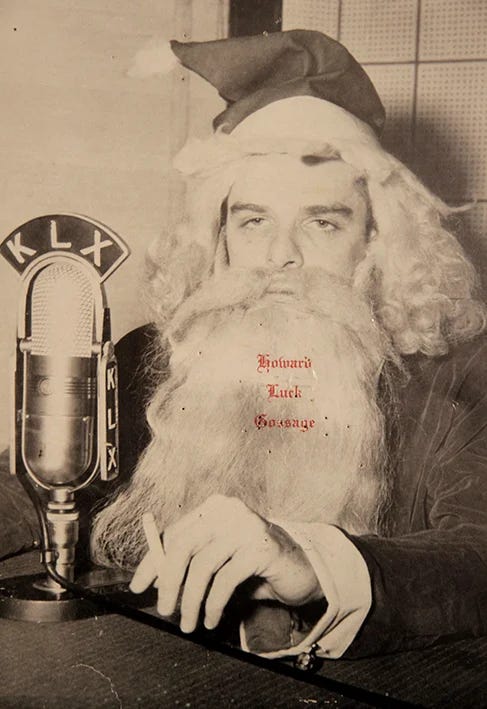
Before radio became a mass medium, listeners would stay up late working their superheterodyne sets, carefully coaxing distant signals out of the static. There was a name for the hobby: DXing.
The social currency of the DXing community was distance. You’d brag the next morning about getting “KWKH Shreveport clear as a bell last night.” Or how you got KFI Los Angeles, or KOA Denver. People cited the call letters and cities together, like a badge.
Radio announcers knew all about this. Which is why they would often open each broadcast with a greeting that was as much a question as a statement.
“Hello out there.”
He did this because he genuinely wasn’t sure if anyone had managed to tune him in.
The advertising legend Howard Gossage would use this story to open lectures on communication theory in the early 1960s. After teaching people about these early days of radio, he would let it sit for a moment, then draw his conclusion about what this can teach you about communication and marketing:
“The audience was eager to listen, and the announcer was eager to talk to them. They both knew who they were and why they were there. They enjoyed an exclusive relationship. They communicated.”
That’s when Gossage would pull out the verbal knives:
Advertising, Gossage would then say, had spent the next thirty years trying to industrialize that relationship. Couldn’t. So instead, it had analyzed the contact itself, isolated it, reduced it to a formula, and called the result creativity.
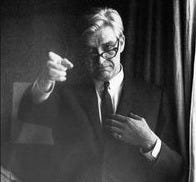
And just like that, “Hello out there” became a broadcast into a void. And nobody on either end was sure who was listening, or why, or whether the connection had been made at all.
You can listen to Gossage deliver the whole speech here:
You are reading my Advertising History Today Newsletter (a sub-newsletter of My OberThinking Newsletter). You can subscribe to it separately. Or, if you are looking for deeper conversations about advertising philosophy, subscribe to the OberThinking Newsletter, and you will automatically be subscribed to this one as well. If you no longer want to receive my Advertising History Today posts, but still want to receive my OberThinking posts, you can manage your subscription here.
What Radio Was, Before It Became What Radio Is
It’s worth sitting with what Gossage was describing, because it’s easy to hear it as nostalgia and miss the structural point.
The early DXing radio relationship worked not because the technology was charming or the content was better, but because both parties had made a deliberate choice to be there. The listener had invested effort. The broadcaster was genuinely uncertain whether he’d gotten through. But it was that mutual investment (and that uncertainty) that created the conditions for real communication.
The early years of radio were, in this sense, also genuinely remarkable.
By the mid-1930s, radio ownership in American homes had grown from roughly 40% of households to nearly 90%; more families had a radio than had indoor plumbing. But the striking thing isn’t the penetration figure; it’s what people did with the medium. Families gathered in the living room for it in the evenings, with a seriousness of attention that later generations reserved for almost nothing. Neighbors without their own sets ran wires next door to share the signal, a makeshift arrangement that went by the quietly poetic name of the “grapevine radio.” During major boxing matches, living rooms filled with people who’d been invited over simply because someone on the block had managed to tune in. The radio, one man of the era said, was something he’d be willing to dig his own grave rather than lose. An exaggeration, clearly. But you understand what he meant.
What made this intimacy possible, paradoxically, was that the technology was imperfect. The signal required effort. The listener leaned in. And the announcer (or the host, or the president delivering a Fireside Chat to seventy million Americans) understood, instinctively, that the person on the other end was not a captive but a guest. Franklin Roosevelt, whose Fireside Chats were the most listened-to broadcasts in the history of the medium, modulated his voice not to project authority but to suggest conversation. It sounded, to many who heard it, like a one-to-one exchange, the president, sitting across the room, talking directly to you. He was careful to space the chats out. He understood that intimacy has to be earned and that overuse destroys it.
A Very French Connection
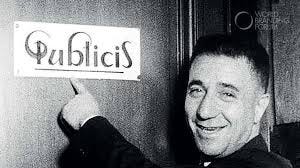
In late 1929, a friend of a very young, twenty-year-old Parisian advertising man named Marcel Bleustein came to him with a peculiar situation. He had a girlfriend who wanted a fur coat. A radio station owed him four thousand francs. Could Marcel convince a furrier called Brunswick to take the airtime in exchange for the coat?
Brunswick was not keen to do this. Marcel had his own doubts. It took three days to secure approval. He wrote what he later described as a “terribly long message.” Reception in those days was poor, and the commercial was read by what he charitably called a “solum announcer.” From an advertising perspective ut did not sound promising. He went to bed expecting nothing.
The next morning, two elegant women who had heard the broadcast walked into Brunswick and bought more than four thousand francs’ worth of furs.
Marcel had not been expecting this. He hadn’t been entirely sure anyone was listening. That uncertainty, it turned out, was part of the point.
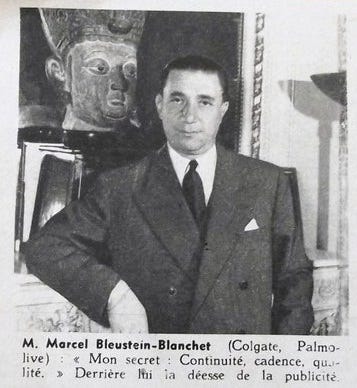
He quickly began incorporating radio advertising into his agency. To do that, he had to build the infrastructure for something that didn’t fully exist yet. He visited every private provincial station in France and offered them exclusive advertising contracts in exchange for guaranteed annual revenue. He invented an arrangement with government-owned public stations (which were forbidden from carrying advertisements) whereby sponsors’ names were mentioned as prize donors rather than advertisers, “that’s not advertising,” he told the skeptical station manager in Bordeaux, “only information,” and it worked well enough that other public stations followed.
He ended up with twenty exclusive contracts covering stations across France, Morocco, Tunisia, and Algeria. He was, by his own description, selling clients a medium that didn’t yet fully exist, or, as he put it with characteristic precision, helping to create it by guessing and believing in what it was to become.
The Networks, the Politicians, and Pierre Laval
It did not last unchallenged, of course. It never does.
The French government had been watching the growth of commercial radio with the particular unease of an institution that suspects it is losing control of something important. In 1933, the minister responsible for broadcasting issued a decree banning all advertising on public, state-owned stations. The prize-mention arrangement that Marcel had carefully constructed was gone overnight. The twenty contracts he had built over four years, the relationships, the formats, the audiences: all of it predicated on access that had just been revoked by ministerial fiat.
Which left only the private stations.
But the private stations, now the sole remaining option for any advertiser who wanted to reach a radio audience, understood their new position rather well. And just like that, the rates that had been reasonable became suddenly unreasonable. The partners who had been grateful became demanding. Marcel spent, by his own account, an inordinate amount of time and energy fighting rate increases from people whose businesses he had created, stations whose audiences existed, in no small part, because Marcel had spent years convincing advertisers to fund the programming that built them.
The final straw was Radio-Lyon, controlled by a politician named Pierre Laval, a man who would later become Marshal Pétain’s Prime Minister in the Vichy regime, though at the time he was merely a rising political figure with a radio station and an appetite for leverage. When Laval demanded an exorbitant rate increase, Marcel said no.
Marcel had a problem.
He had already lost the public stations by government decree. Now he was losing the private ones to extortion. The infrastructure he had built over six years was being used against him, simultaneously, by the state and by the people who had benefited most from his work.
So he did the thing that, in retrospect, seems obvious but at the time was considered audacious to the point of recklessness:
The Midnight Experiment
He bought a weak station on the outskirts of Paris. His lawyers advised against it: the owner refused to disclose the full extent of the liabilities, would say only “not much, really.” Marcel took the risk, assumed the undisclosed debts, and paid three and a half million francs for something he wasn’t entirely sure anyone was listening to.
Which is precisely what he set out to find out.
He was touring his new facilities late one night with his cousin Edward Gross, who happened to own a cinema nearby called Studio 28. The entire technical operation of the station was run by a single man who tripled as operator, electrician, and announcer, jumping between the microphone and the turntable, a one-man phantom station broadcasting into the Paris night. Marcel stood there in his own studio, looking at this arrangement, and asked himself the very same question that radio hosts asked during the days of DXing:
Hello out there?
To find out, he devised a test. He asked Edward for a handful of free cinema tickets and had the announcer read a brief offer: call before midnight and receive two free passes to Studio 28. It was 11:30 PM.
They waited ten minutes in silence. The first call was a wrong number. Then a real call. Then two. Then ten. Then twenty. What he discovered once again blew his mind:
“In the middle of the night, men and women were listening to this third-grade station. They stayed up to listen to another person, to a human voice and to the music of the spheres. That night, I really understood radio.”
What Marcel understood intuitively, I think, was something no amount of theorizing could have produced. Radio was not a broadcast medium in the way that newspapers were a print medium. It was a relationship. The listener had chosen to be there, had stayed up past midnight, in the dark, with a cumbersome set, to be in the presence of another human voice. The broadcaster was speaking to someone rather than at everyone.
Books and newspapers, Marcel observed in his autobiography, were isolating media; you had to be alone and quiet to receive them, and they handed you a well-organized version of the world, headlines lined up like soldiers in a parade. But radio was different. With radio, he wrote, “you get the world itself. Not a translation of it. The thing. A voice that might not even know you were there.”
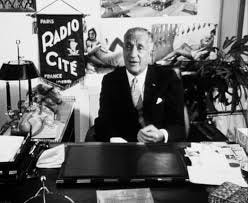
He renamed the station Radio Cité (to sound like Radio City Music Hall), moved the studio to his agency offices on Boulevard Haussmann, installed a taller antenna, and began building something from what he had learned at 11:30 PM with twenty phone calls and a handful of free cinema tickets.
Radio Cité and the Fight Worth Having
What he built was not, primarily, an advertising vehicle. It was, to put it into his very French own words, “a love affair with an audience.’ The secret, he says, was the his team was very young (both age wise and at heart) and was having a ball. They dispensed with the “canned radio” of the other stations (the accordion here, the concert there, the stuffy announcer parceling out entertainment in neat slices to a public treated, as he put it, like children) and brought the audience into the programs. They put ordinary people in front of the microphone. They invented the quiz show, the news magazine of the air, and the public participation format.
They even gave Edith Piaf her first broadcast, unannounced, between two song programs, one evening at 7:30, and within minutes the switchboard was jammed with calls asking for more.
The letters came in the hundreds, then the thousands, then 40,000 for a single program. The way Marcel described what was happening between Radio Cité and the public is equality eye opening: “they fell in love, discovered each other.” He talked about going on air each day with the distinct impression that the audience was “physically there at the other end.” The microphone, he said, was “a collective ear.”
“With the microphone in your hand, you are communicating directly with hundreds of thousands of listeners — with each of them individually. They are out there, existing at the same time and at the same rhythm as you are. That is precisely what they are asking from you: a share of existence.”
And the advertising?
Marcel had a lot of work to do. Many business leaders didn’t listen to the radio. They were skeptical. But Radio-Cite changed all that. Marcel loved to answer the question about how well the advertising did on his station by telling the story of a company president who had his doubts about radio until one morning, his secretary, a woman with whom he was not on good terms, beamed at him: “I listened to your concert last night on the radio. It was so beautiful. Thank you so much.” He became, Marcel noted, “a true believer right away.”
According to Marcel, the advertising on Radio-Cité thrived precisely because it was embedded in the special relationship with the audience rather than interrupting it. The sponsors were not buying space between content; they were being associated, through Marcel’s programs, with something the audience genuinely loved. Or as he put it:
“Radio is life itself. It is a pure instant instantaneous medium in perpetual renewal. With radio, life flows along, and your mistakes are part of it. With the microphone in your hand, you are communicating directly with hundreds of thousands of listeners with each of them individually. They are out there existing at the same time and at the same rhythm as you are. That is precisely what they are asking from you: share of existence. You can do anything on radio provided you are smack in there, running with life.”
The public, he observed, gave the sponsors credit for the shows they loved so much. “People were very grateful, so they bought the advertised goods.” The mechanism was not persuasion in the conventional sense. It was something older and more durable: gratitude.
In the years that followed, Marcel (who would later add Blanchet to his name after World War II) would grow his agency, Publicis, into one of the largest advertising holding companies in the world.
The Lesson He Left
Marcel Bleustein-Blanchet’s insight (arrived at empirically, without theory or structure, through a series of midnight experiments and fur coat transactions and fights with politicians) was essentially this:
Radio worked as an advertising medium to the precise extent that it remained a relationship between a specific voice and a specific audience. The moment it became a delivery mechanism for messages from strangers, something essential was lost. As Marcel himself pointed out later in life, all this changed as Radio scaled. Because in order for the medium to scale, it needed to eliminate the conditions that made the intimacy possible.
The listener no longer had to lean in; the signal arrived whether they wanted it or not. The broadcaster no longer faced any real uncertainty; he simply transmitted in all directions and trusted that some percentage of the population was, at that moment, unable to leave the room. The relationship became asymmetric. One party was sending. The other was, in varying degrees, trapped.
And if the sender of a message cannot earn the audience's willing participation, whatever he achieves is closer to coercion than to communication, the advertising equivalent of gunboat diplomacy. Because while you can compel attention. You cannot compel persuasion. And a medium built on compelled attention, however efficiently targeted, is doing something quite different from what Roosevelt or Bleustein-Blanchet, or the DXing announcer, uncertain whether his signal had made it through, was doing.
But nobody questioned this very loudly, because the sales numbers were acceptable. The industry declared the transaction a success and moved on. That is, until TV became the dominant medium. And then the internet. Radio, it seemed, was doomed to become legacy media. And then Steve Jobs invented the iPod, and with that coined a new term:
The podcast.
And Who Is Learning It Now
Podcasting, in its early years, recreated the DXing conditions almost entirely by accident.
The listeners who found independent podcasts in 2008 or 2012 had to work for it. There were no platforms that hosted these things. They were not an algorithmically targeted audience. They were simply people who, for one reason or another, discovered and sought out a specific voice, on a specific subject, through a medium that still required some effort to navigate. They were, in the Gossage sense, eager to listen. And the hosts, working from spare bedrooms and kitchen tables, with equipment that was still mostly too expensive and complicated, were a lot like that radio announcer Marcel found in his newly purchased station at midnight. Doing everything and uncertain whether anyone was actually on the other end, but were, nevertheless, eager to talk to them.
Both parties knew who they were and why they were there. In other words, they communicated
And the advertising that grew up around this was shaped by those conditions. Host reads were actually host reads because, well, the host was the show. And more often than not, the host actually believed in the product, or at least, grateful for the support, had taken the time to believe in it. An independent creator doesn’t read an ad for something they find embarrassing because they have calculated the reputational cost. They do it because they have developed, over years, a working theory of their relationship with their audience, and they are not willing to violate it for a CPM. Because of this (and because no one was really watching any clock, these reads were often longer and more genuine endorsements, because the host understood that the trust their audience extended was the entire asset.
The Accidental Rediscovery
Like traditional radio, podcasting (and the many shows that started it all) had to scale. And with that, they got co-opted by the same stale frameworks that destroyed the audience/program relationship in radio. And this scaling naturally affected advertising effectiveness.
But unlike radio (with its limited wavelengths and infrastructure, the spirit of anyone picking up a mike and calling out “Hello Out There” never went away. Independent podcast creators are popping up every day.
Today, eighty percent of today’s top-performing shows are independent. And these independent creators, the ones who still take the onboarding call, who cap their ad minutes because they understand what the relationship costs to maintain, who deliver ninety-second reads because the story requires it, still outperform major non-independent networks on advertiser performance targets by 37%. On every measure: authenticity, message clarity, call-to-action delivery, and personalization. Statistical confidence exceeds 99% across 81 advertisers and eighteen months of campaign data.
Non-independent shows, however, are now five times more likely to use a producer or announcer read. Programmatic insertion has made it possible to strip a host’s voice from their own back catalogue and replace it with a stranger’s. Twenty minutes of dynamically inserted audio per hour has become routine on some platforms. The logic is the same logic that killed the DXing relationship in radio: it is more efficient to broadcast than to communicate, and efficiency is easier to measure than trust.
And yet, despite all these numbers and facts, most big brands (and their big agency partners) still choose to advertise with the other twenty percent.
They Do Not Wish To Be Wrong
In the introduction to his 1960s book “How Business is Bamboozled by the Ad-Boys,” a retired and fampusly irreverent ad and PR man named Nicolas Samstag tells a charming story about why brands make decisions like this.
Samstag and his wife were staying at a grand hotel in Luxor, Egypt. When the bill arrives, there is a significant error. But the error, he noticed, was in their favor. They were being substantially undercharged. Being the good Samaritan, Samstag tried to correct it by explaining the mistake to the cashier, but was shocked when the same cashier, who had just moments ago been speaking perfect English, suddenly pretended she didn’t understand and called the manager. So Samstag explained the error again. And once again, the manager acts as if he has no idea what he is talking about. Finally, the concierge walks over, listens quietly, then touches Samstag’s shoulder, pulls him aside, and says with a gentle smile: “Pay, please? It will be easier. They do not wish to be wrong.”
The hotel, in other words, would rather accept less money than it was owed than admit that its system had failed.
That is exactly what is happening in podcast advertising in 2026.
The major networks have sales teams. They have managed vendor lists. They have seats at the agency's upfront table and quarterly business reviews and programmatic dashboards that make the buy look sophisticated, and the outcomes look acceptable.
The director of marketing at a big brand and the media buyer at a holding company are not compensated for discovering that an independent show nobody has heard of outperforms the entire managed list by 37%. And even if they knew that to be true, getting that show approved would require admitting what they were doing was not the best strategy, and so they would rather accept a worse outcome than acknowledge that the system that produced it was mistaken.
They do not, in other words, wish to be wrong.
They wish to keep things comfortable. Even if the price of that comfort is 37 cents on the dollar.
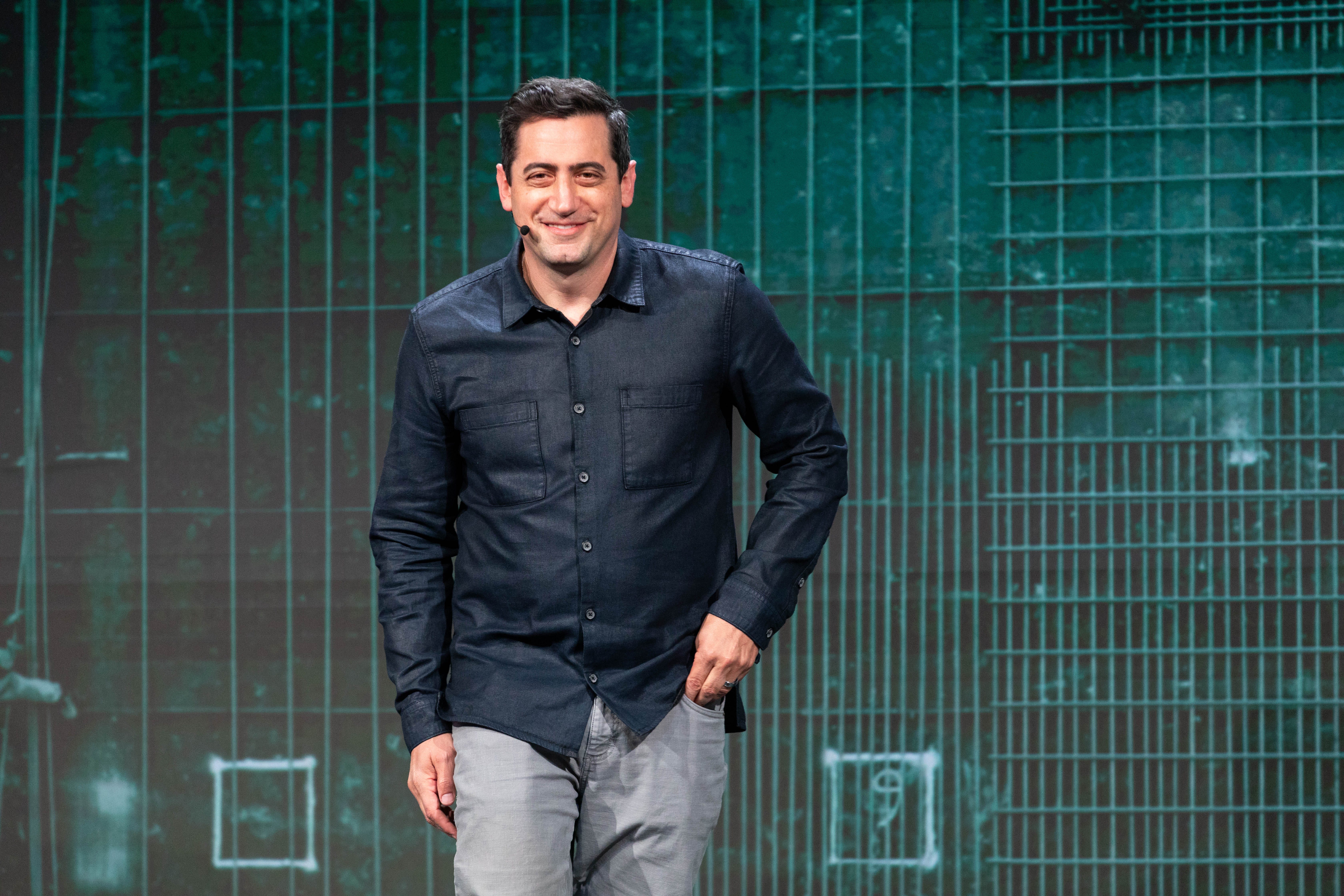
But there is one man trying to fix this. His name is Dan Granger.
The Same Fight, Ninety Years Later
Like Marcel Blaustein-Blanchet, Dan Granger runs an ad agency called, which also happens to be the world's largest podcast advertising agency. Which makes sense when you consider that he has been in audio since 2003, first selling ads for radio, then for the first podcasts, and watched, first hand, as this medium got built by people who had something to say and refused to wait for permission.

His agency, Oxford Road, has spent years assembling performance data across billions of dollars in podcast campaigns, partly because the data is useful, but mostly because he seems to understand, the way Marcel understood, that belief requires evidence when the people you’re trying to convince are looking at their spreadsheets and not listening to the shows.
The parallel is not decorative.
Marcel, in 1929, was selling clients a medium they didn’t listen to, for audiences they couldn’t see, on the basis of a relationship he could feel but hadn’t yet proved. First, he built the infrastructure and the network of stations. And when the networks and the politicians tried to capture that infrastructure for their own purposes, he built something new rather than capitulate. He built his own station, studio, formats, and audience-participation programs because he believed that what he had understood at midnight in his own barely functional studio was true, important, and worth building around.
With the same intuition as Marcel, Granger is doing something structurally similar. And what he is fighting is the same thing Marcel fought: the tendency of established systems to price comfort above performance, to prefer the familiar vendor list to the inconvenient evidence, to pay the bill in Luxor rather than admit the arithmetic is wrong.
But Dan also has something that Marcel lacked.
The data.
Which, when assembled properly, turn out to be striking. As Dan points out:
”Independent podcast creators outperform major non-independent networks on advertiser performance targets by 37%. On every individual measure (authenticity, message clarity, call-to-action delivery, personalization), the gap holds. Statistical confidence exceeds 99% across 81 advertisers and eighteen months of campaign data. When hosts are given genuine creative control over their reads, campaigns beat acquisition goals by 65%.”
None of this should surprise anyone who has thought carefully about what Gossage or Marcel was describing. Mutual investment, a genuine relationship, and the condition of willing participation on both sides are precisely what the independent host reads and recreates, and the network announcer spots and destroys.
There’s more data, too.
And all Dan needs now is for more brands and the people who run their advertising to start paying attention. So to do that, he is taking a card right out of Marcel’s playbook.
No, he is not starting his own network of independent podcasts (not yet at least).
He is putting on a show.
Hello Austin!
The podcast industry is in the process of deciding whether to learn from radio history or repeat it. But the choice is not between a principled model and a pragmatic one; the data is clear that the principled model is also the more profitable one. The choice is simply between paying attention to the evidence and not.
Marcel put it as simply as I know how to put it:
“If you wait for things to change before you act, then they change without you. At a certain point, you must let go of your rationality and jump.” He said that about radio in 1929. It applies, with no alteration, to independent podcasting in 2026.
The window that exists right now, the current generation of independent creators building real audiences with genuine relationships, before the acquisitions come and the rates triple and the announcer reads replace the hosts, is the window Marcel is talking about.
Which is why, this Sunday, at SXSW, Dan and Oxford Road and Libsyn are hosting “The Indie PaC Awards,” the first-ever award show dedicated to independent podcasters and Creators. It is, among other things, a ceremony for creators who are still doing what Marcel described: communicating directly with hundreds of thousands of listeners, each one individually, staking their voice and reputation on it. But it will also be a show for brands to witness, first-hand, just how powerful that relationship can be.
Every podcast that today commands a premium rate was, at some earlier point, an independent creator that a brand could have partnered with when the audience still had to work a little to get there.
The window that exists right now, the current generation of independent creators building real audiences with genuine relationships, before the acquisitions come and the rates triple and the announcer reads replace the hosts, is the same window Marcel is talking about.
Oh, and the award show will also be MCed by Killer Mike.
WHEN: Sunday, March 15th,
TIME: 4:30–7:00 PM
WHERE: Skybox on 6th.
I have three invitations for brand marketers and CMOs who will be in Austin at that time.
Reply here or find me on LinkedIn. The room will be full of people who heard the midnight phone ring and understood what it meant.
Hello out there!
- Justin Oberman
America’s Advertising Philosopher

My store: stan.store/justinoberman
My LinkedIn: linkedin.com/in/justinoberman
My newsletter OberThinking is about advertising history, philosophy, persona branding, and what happens when everyone has access to the same tools. Hint: the only thing that matters is what you think about them.
Really love these pieces with more of the history of advertising in them - I always find them so much more compelling than the AI stuff and learn so much that also makes me think in different ways about marketing/advertising, so thanks for continuing to write them!