

How creative thinkers use AI
AI can learn everything about how you work. That’s the problem

Last week OpenAI launched Codex.
Codex learns your workflow. It studies how you work, your patterns, your preferences, your process, and becomes increasingly good at anticipating what you need before you ask for it.
For most professional tasks like logistics, coding, scheduling, and a hundred other repetitive decisions that eat time without producing anything genuinely new this week a tool that learns your workflow and removes friction is useful.
But there is a category of work where learning and repeating your workflow is not an advantage.
And that category is creative work.
And the reason most people will not notice this distinction and will enthusiastically adopt Codex for their creative process the same way they adopted every other AI tool, is because most people do not actually know what the or their creative process is.
And that’s because the creative process is not an optimized workflow.
It is the deliberate disruption of one.
Most people, if asked to describe their creative process, will describe a production process.
They sit down. They open their tools. They generate material. They refine it. They ship it.
Or they study something intensely, write down a few ideas, and then do something commonly called “incubating” and somehow during that incubation process ideas suddenly emerge.
But what is being described there is not really a process. It’s more of a manufacturing process with creative-sounding inputs.
A genuine creative process has one defining characteristic that manufacturing processes do not.Abby.
What The Creative Process Actually Is
Every genuinely new idea in the history of human creativity came from someone who was paying attention to something that had nothing to do with the problem they were trying to solve.
John von Neumann was not at a poker table thinking about economics. He was at a poker table thinking about poker. The connection happened because he was somewhere unexpected and his mind, trained on a different problem, recognized a pattern that the economists who stayed in their offices never could.
Charles Eames was not designing chairs when he made plywood splints for wounded airmen. He was solving a medical problem. The chair came later, when the solution to one problem became the raw material for another.
Knute Rockne was not at a burlesque show thinking about football. He was at a burlesque show watching dancers. The backfield shift came from a chorus line because a football coach was somewhere a football coach was not supposed to be.
In other words, new ideas do not come from looking harder at what you already know. They come from looking elsewhere, from the productive collision between a problem you are carrying and an idea you found somewhere it had no business being.
Why AI Cannot Do This
Codex learns your workflow.
Your workflow is the path you already take. that involve the tools you already use and the sequence you already follow.
And AI is very good at doing this because that is what AI was built to do.
It is a pattern recognition and prediction machine.
So all it is doing is picking up on the patterns you have already established through repetition.
A tool that learns your workflow and optimizes it is a tool that makes you better at going where you already go.
But that is exactly the opposite of what the creative process requires.
Because the creative process requires going somewhere you have never gone and finding the connection between that place and the place you are usually at in way that does not exist yet.
If you ask AI to make the sleep, it will do so by trying to create a pattern out of it. But patterns are exactly the thing that creativity breaks.
AI cannot make that break because AI is a pattern recognition system.
It finds patterns in what already exists and optimizes for what has already worked. It learns what you do and gets better at helping you do more of it.
What it cannot do bevause l it is architecturally incapable of doing it is generate the genuine randomness of the productive accident and unexpected collision of two things that had no reason to be in the same room. We’re in the case of the AI, screen..
The Prospector’s Problem
If you look in the same old places, you will find tapped out veins.
Miners who find gold are rarely the ones who dig deeper into the mines everyone else is digging in. Miners who find gold are usually the ones who go somewhere nobody had thought to look, who followed a hunch, took a wrong turn, and ventured off the path that the more efficient miners had long since optimized.
This is because efficiency, in prospecting, is a trap.
The efficient miner works the known veins harder.
The creative miner goes looking for new ones.
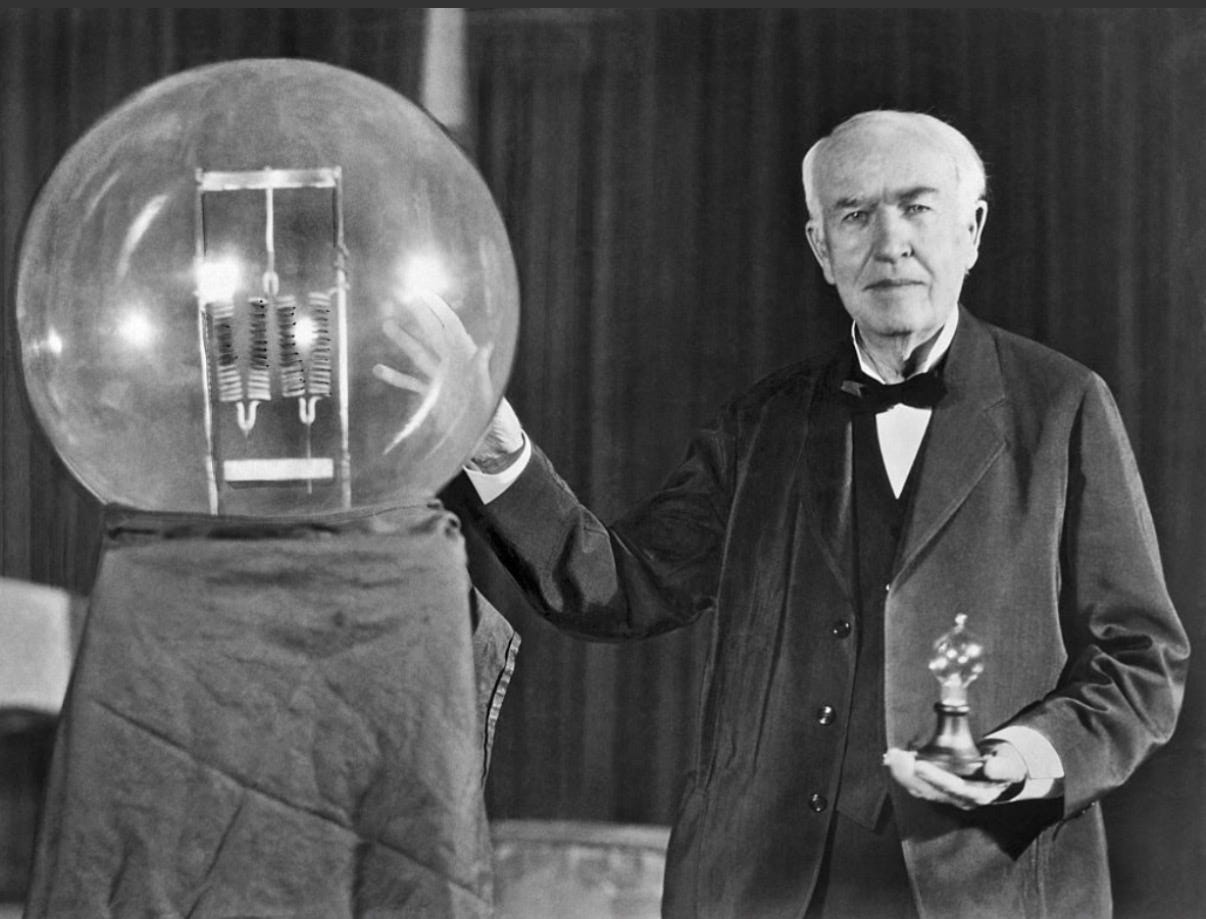
Thomas Edison understood this so well that he gave his lab colleagues explicit instruction:
“Make it a practice to keep on the lookout for novel and interesting ideas that others have used successfully. Your idea has to be original only in its adaptation to the problem you are currently working on.”
Not original in its source.
Original in its application.
The idea can come from anywhere. The creativity is in not in the collision. It’s in recognizing that something from over there solves a problem over here.
But you cannot make the collision or recognition if you never go over there.
A tool that learns your workflow will make over here more efficient. It will optimize the path you already take. It will remove friction from the process you already follow. But it will never take you over there.
The Setup
The protocol prompt for paid subscribers this week is a structured cross-domain idea hunting system.
This is not the same thing as a brainstorming technique.
Nor is this a creativity prompt. It is a way to use AI in way that creates a deliberate friction that forces you to go somewhere your workflow and AIs workflow does not and will not take you, and helps you bring back what you find so that you start making collisions.
And if you ask me it teaches you how to use AI in the only way I think AI is genuinely useful for creativity: not to generate ideas, but to help you follow connections once you have found the raw material yourself.
The Prospector’s Protocol: A System For Finding Ideas Where Nobody Else Is Looking
This protocol comes in two parts.
Part 1 is the practice itself: what you do, how you do it, how often.
Part 2 is how AI enters after the prospecting is done.
PART 1: THE PROSPECTING PRACTICE
The core move here is to create a deliberate domain displacement.
