

Stop extending your weaknesses
Or: How to use Artificial Intelligence without becoming Artificially Intelligent

There is a quote by a lady named Joaanna Maciejewska circulating among the technological optimists, those relentlessly sunny people who believe every new gadget will finally deliver us into paradise, that goes something like this:
“I’m not going to use AI to be creative so I can do the dishes. I’m going to use AI to do the dishes so I can be more creative.”
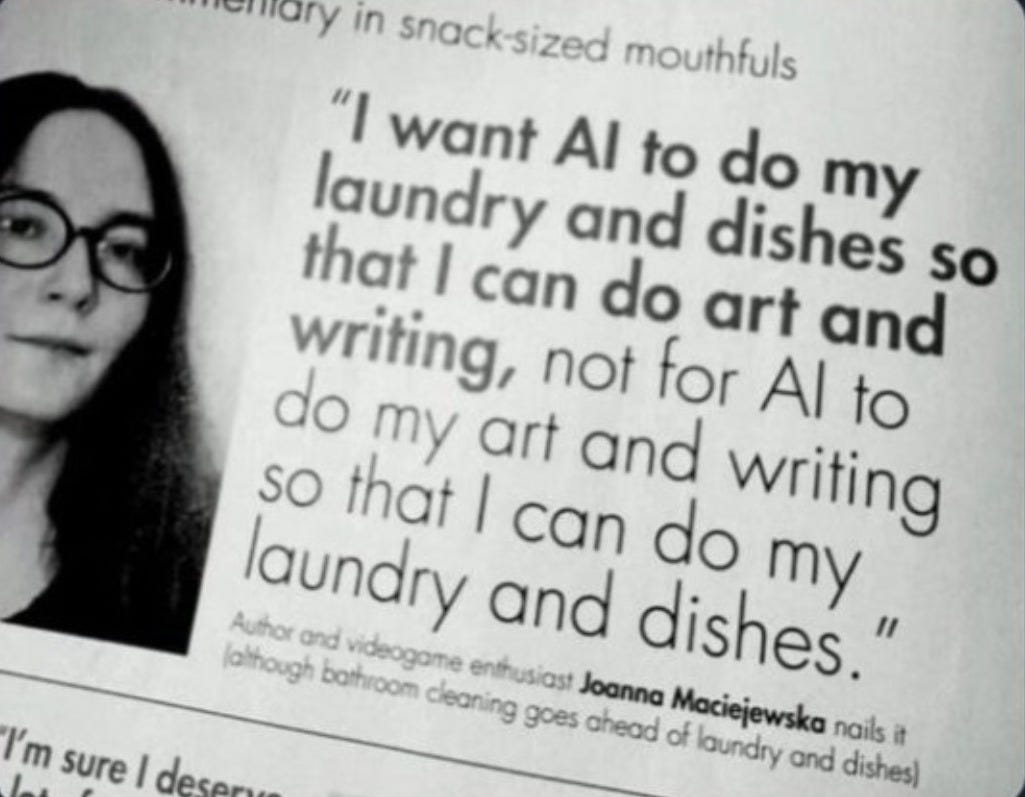
It’s very pretty.
It sounds inspirational.
It’s also, I suspect, almost entirely backwards.
Now, before the optimists reach for their pitchforks (if they own pitchforks, more likely they’ll reach for their phones to compose an angry tweet), let me concede the obvious:
If AI could literally scrub your casserole pan while you painted your masterpiece, who could argue? The dishes metaphor, in its pure form, is unobjectionable. Tedium is tedium. Outsource it if you can.
The problem is not so much the metaphor as how it has metastasized.
Because what people have taken from this bit of folk wisdom is something far more dangerous:
Use AI to do the things you’re bad at, so you can spend more time doing what you’re good at.
Which sounds perfectly reasonable.
Unfortunaterly it’s also perfectly dangerous.
The Extension Problem
Marshall McLuhan (that peculiar Canadian professor who understood media better than most practitioners ever will) gave us a framework that applies here with uncomfortable precision. He observed that "all media are extensions of some human faculty—psychic or physical." The car extends your legs. Television extends your eyes. Clothing extends your skin. The telephone extends your ear and voice.
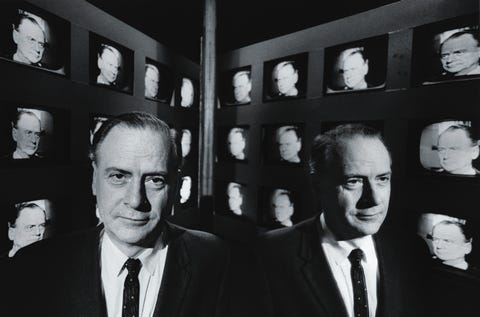
I know that seems perfectly obvious. McLuhan would have said that’s precisely the problem.
Because for McLuhan, the interesting question was never simply which part of your body a technology extends. The interesting question was what happens between technologies (and between you and other people) once the extending begins. Every new extension changes the ratios among all your senses and all your tools, the way adding a tuba to a string quartet doesn’t just add bass; it transforms every other instrument’s role in the room. Or as Professor McLuhan put it:
“What I am saying is that media as extensions of our senses institute new ratios, not only among our private senses, but among themselves, when they interact among themselves. Radio changed the form of the news story as much as it altered the film image in the talkies. TV caused drastic changes in radio programming, and in the form of the thing or documentary novel.”
Radio didn’t just extend the ear. It rearranged the newspaper, the photograph, the film. Television didn’t just extend the eye. It gutted radio’s format and reinvented the novel. Each extension ripples outward and rearranges everything it touches.
Which brings us to the machine that is rearranging everything at the moment.
The world is still debating what exactly AI extends. Some say it’s thinking itself. Others say creativity. I believe—and I am neither contented nor arrogant in this answer—that AI is fundamentally an extension of the left brain: the analytical, pattern-matching, language-processing apparatus that handles the mechanics of cognition.
McLuhan, had he lived to see it, might have gone further. He was already reaching in that direction when he wrote:
“Today, after more than a century of electric technology, we have extended our central nervous system itself in a global embrace, abolishing both space and time as far as our planet is concerned. Rapidly, we approach the final phase of the extensions of man—the technological simulation of consciousness, when the creative process of knowing will be collectively and corporately extended to the whole of human society, much as we have already extended our senses and our nerves by the various media.”
“The technological simulation of consciousness.” He wrote that in 1964. It took us sixty years to build something that made the prophecy feel less like poetry and more like a product announcement.
(Thank you Andrew McLuhan for providing me with the appropriate quotes).
Scaling to Zero
But whether AI extends the left brain or consciousness itself or something else entirely, one thing is certain, and this is the point that matters more than settling any academic debate: whatever AI extends, it extends a part of you.
And not just a part. McLuhan was adamant that you cannot extend one thing without affecting everything else:
“There is little possibility of answering such questions about the extensions of man without considering all of them together. Any extension, whether of skin, hand, or foot, affects the whole psychic and social complex.”
Read that again, please. I’ll wait.
Because this is not a question of technique. It is a question of identity.
It means that what you use AI for has even more profound implications than how you use it. Every time you extend a capability through AI, you are rearranging the ratios of your entire self, your skills, your judgment, and your relationship to your own competence.
If you use AI to amplify skills you don’t possess, you are extending nothing into something.
And nothing times ten is still nothing
Nothing times a billion is still nothing.
And nothing extended by the most sophisticated artificial intelligence ever constructed is, I regret to inform you, still nothing
So when you use AI to do things you are not good at, you are building a prosthetic limb for a phantom. You are, in the language of our time, scaling zero.
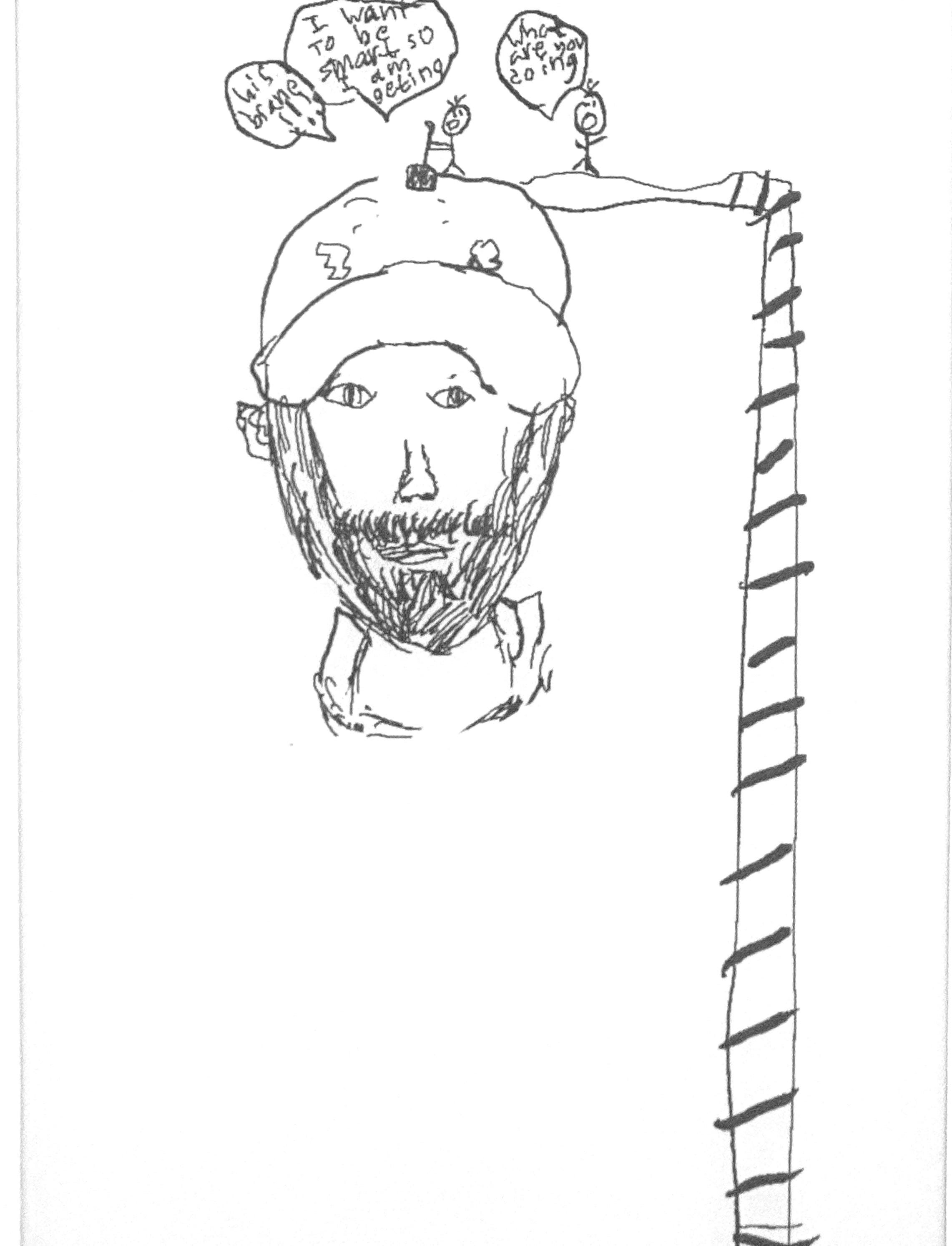
The Mechanical Reality of Incompetence.
Here is the fundamental problem with using AI for things you’re not good at, stated plainly:
You don’t know what you don’t know.
When you are genuinely skilled at something, when you have earned your expertise through the long apprenticeship of failure and correction that real mastery requires, you possess three things that the amateur cannot simulate:
First, you know what to ask for.
You understand the specifications. You can describe the outcome you want with precision because you have seen it, produced it, and refined it a hundred times. You know the vocabulary of your craft.
Second, you can recognize quality.
When the AI hands you its output, you can evaluate it. You can spot the subtle wrongness, the amateur tells, the places where the machine has produced something superficially plausible but fundamentally flawed.
Third, you can iterate intelligently.
You know which direction to push. You can give feedback that matters. And you can collaborate with the machine in a genuine sense, rather than merely accepting whatever it offers.
The amateur, however, possesses none of these.
He cannot frame the question because he doesn’t understand the domain.
Nor can he judge the answer because he has no standard of comparison.
He also can’t improve the result because he doesn’t know what improvement looks like.
But It Gets Even Worse
Let me give you an example that I trust will sting, because it should:
A man who cannot write asks AI to write his company’s marketing copy. The AI produces something. He reads it. “Wow,” he says, “that’s amazing!” And perhaps it is, by his standards. But his standards were formed by incompetence. He has no idea whether it’s actually good. He doesn’t know the difference between prose that persuades and prose that merely sounds persuasive. He cannot distinguish rhythm from noise, structure from chaos, the precise word from the merely adequate one.
Meanwhile, everyone who reads his copy knows instantly that it was written by a machine for a man who couldn’t tell the difference. The tells (to use Gen Z slang) are everywhere; the mediocrity is palpable, and our protagonist keeps believing he has solved his problem, when all he has done is democratized his ineptitude at scale.
I have spent thirty years in the business of persuasion, and I can’t tell you many things for certain, but I can tell you this: there has never been an easier time to spot someone who doesn’t know what they’re doing.
Because when you use AI to substitute for skills you lack, all you are really extending is your weaknesses. Worse, you are producing more of what you were never any good at in the first place.
AI has given incompetence a megaphone.
The Better Way
Now let us consider the opposite approach, the one I am proposing, the one that sounds counterintuitive until you think about it for more than fifteen seconds.
You should only use AI only for what you are already good at.
For example, when a skilled writer uses AI to write, she knows exactly what to ask for. She can evaluate every sentence. She can push back, redirect, and refine. In other words, she uses the machine as a collaborator and amplifier, not a replacement. The result at the end is her work, enhanced. Not the machine’s work, tolerated.
The same thing can be applied to a skilled analyst who uses AI to analyze data. He knows which questions matter. He can spot when the model has hallucinated or misinterpreted. He can integrate the machine’s speed with his own judgment. The result are his insights, accelerated. Not nonsense, automated.
This is what extension means in McLuhan’s sense.
The car doesn’t give you legs. It extends the legs you have. It makes your movement faster, farther, and more powerful. But if you have no legs, the car means nothing. You’re just sitting in a box.
When you use AI to enhance skills you already possess, you are extending the best parts of yourself. You are taking your genuine capabilities and amplifying them. You are doing what you do, only faster, and at a greater scale, and with fewer tedious intermediate steps.
The Social Contract
“But wait,” I hear someone saying (there is always someone saying this), “what about the things I need done that I can’t do? Should I just not do them?”
Of course not. But what I would recommend is to do what humanity has always done when faced with its limitations:
Hire someone who can.
This is not a radical proposal. This is the foundation of civilization. Division of labor exists because people have different skills. Specialization exists because excellence requires focus. The whole economic fabric of human society is woven from the simple truth that I can do what you cannot, and you can do what I cannot, and together we accomplish more than either of us alone.
And here is the beautiful part:
If everyone followed the principle II laid out above (of only using AI for what you are good at) then the person you hire would also be using AI, but to enhance their genuine expertise, not to fake yours.
Such a world strikes me as a kind of AI Shangri-La.
Picture this:
You are excellent at product design but terrible at legal contracts. Instead of asking AI to write your contract (producing something you cannot evaluate and that any competent lawyer will immediately recognize as amateur), you hire a lawyer. That lawyer is excellent at contracts, and she uses AI to work faster, to check her reasoning, to ensure she hasn’t missed anything (maybe even to customize it to your specific needs). The result (in both cases) is genuine expertise, augmented by technology.
Now compare this to both of you using AI for what you’re bad at:
You produce fake-looking contracts, she produces fake-looking product designs, both of you extending your incompetencies into the world like two blind men swapping canes.
I don’t know about you, but I know which world I’d prefer to live in.
A Necessary Clarification
Before the objections mount too high, let me be precise about what I am not saying.
I am not saying you should never use AI to learn something new.
If you are genuinely trying to acquire a skill (if you are studying, practicing, building competence through the hard road of actual education), then by all means use every tool available. AI can be an excellent tutor, a tireless practice partner, a patient explainer of things you don’t yet understand.
The distinction is this:
There is a difference between using AI as a crutch for producing output you can’t evaluate and using AI as a scaffold for building competence you intend to possess.
If you are learning to write, and you use AI to get feedback on your writing, to understand why your sentences don’t work, to see examples of better approaches, then this is education. You are building the muscles.
If you are not learning to write, and you use AI to produce writing so you never have to learn to write, then this is a form of substitution. You are not extending anything. You are actually atrophying the muscles you never had.
So the question you should be asking yourself isn’t “am I using AI?” The question you should be asking yourself is, “Am I becoming more capable, or less?”
The Dark Side of Outsourced Competence
There is something else here, something most people prefer not to acknowledge. So naturally, I am going to acknowledge it.
When you use AI to do what you’re bad at, you are not merely producing inferior output.
You are also deceiving yourself. But even worse than that, you are, technically speaking, deceiving others.
You are, in a word, presenting work as if it represents your capabilities when it does not. You are claiming competence you do not possess. You are, in the precise meaning of the term, not plagiarizing per se, but nevertheless a fraud. And I’m sorry to be the one to tell you this (and say it out loud), but the fact that millions of other people are committing the same fraud does not make it less fraudulent. It merely makes it more common.
I am not moralistic about many things.
I believe that power is neither good nor bad; it simply is. I believe that strategy is the art of winning, and generals and bosses must make terms with their own consciences.
But I also believe that hypocrisy (the art of pretending to feel something you do not feel, or to be something you are not) is corrosive in a particular way. Not because it offends some abstract moral code, but because it undermines your own sense of what is real.
When you use AI to fake competence you don’t have, you begin to lose track of what you actually can do. The lines blur. You start to believe your own marketing. And that way, as every marketer knows, lies disaster because sooner or later, you will be called upon to perform without your prosthetic. And you will not be able to.
A Practical Guide for the Brave
Now, I promised practical tools. And unlike many who promise such things, I intend to deliver them, not because I have any particular desire to be helpful (I don’t), but because empty advice is worse than silence, and I have already spent too many words on this to abandon you now.
What follows is a system of prompts and protocols for those who take this principle of AI expertise seriously. It requires that you actually know yourself. But more importantly, it requires honesty.
These are requirements that will eliminate most readers immediately.
For the remainder: carry on.
Part One: Discovering What You’re Actually Good At
This is for the people who do not yet know what they are truly experts in. There are more people like this than you think. If you are one of these people, you already know it. But there are also people in an even more unfortunate position. I am talking, of course, about the people who think they are experts in one thing when they are really experts in another. In either case, before you can figure out what you should be using AI for, you need to know what you are good at.
Luckily, there is a solution.
If you have been using an AI assistant with memory enabled (Claude, ChatGPT, Gemini, or whatever mechanical oracle you prefer), it has been watching you. It knows what you ask about. It knows where you excel and where you struggle. It knows you better than you know yourself, which is not saying much, since most people are strangers to their own natures.
Use this.
Ask your AI to help you see yourself clearly.
Here is a prompt you may use:
“Based on our conversation history, I want you to analyze my patterns of interaction with you. Where do I seem to have genuine expertise—asking sophisticated questions, catching your errors, pushing back on your suggestions with good reason? And where do I seem to be operating beyond my competence—accepting your output uncritically, asking basic questions that reveal unfamiliarity, unable to evaluate whether your responses are good or bad? Be honest. I can take it. I need to know what I’m actually good at versus what I merely wish I were good at.”
Note: This requires that your memory feature be enabled. If you have been carefully erasing your history like a spy covering tracks, you have only yourself to blame for the machine’s amnesia.
Part Two: Building Prompts That Extend Your Strengths
Once you know what you’re actually good at, the next step is to craft prompts that leverage that expertise. There is, of course, a problem to this. A prompt for one type of expert looks nothing like a prompt for another type of expert. The prompts for one type of expert contain assumptions, specifications, and constraints that another type of expert cannot even conceive of.
So here is a meta-prompt (a prompt that builds prompts) designed for this purpose:
