

Personal branding is simple

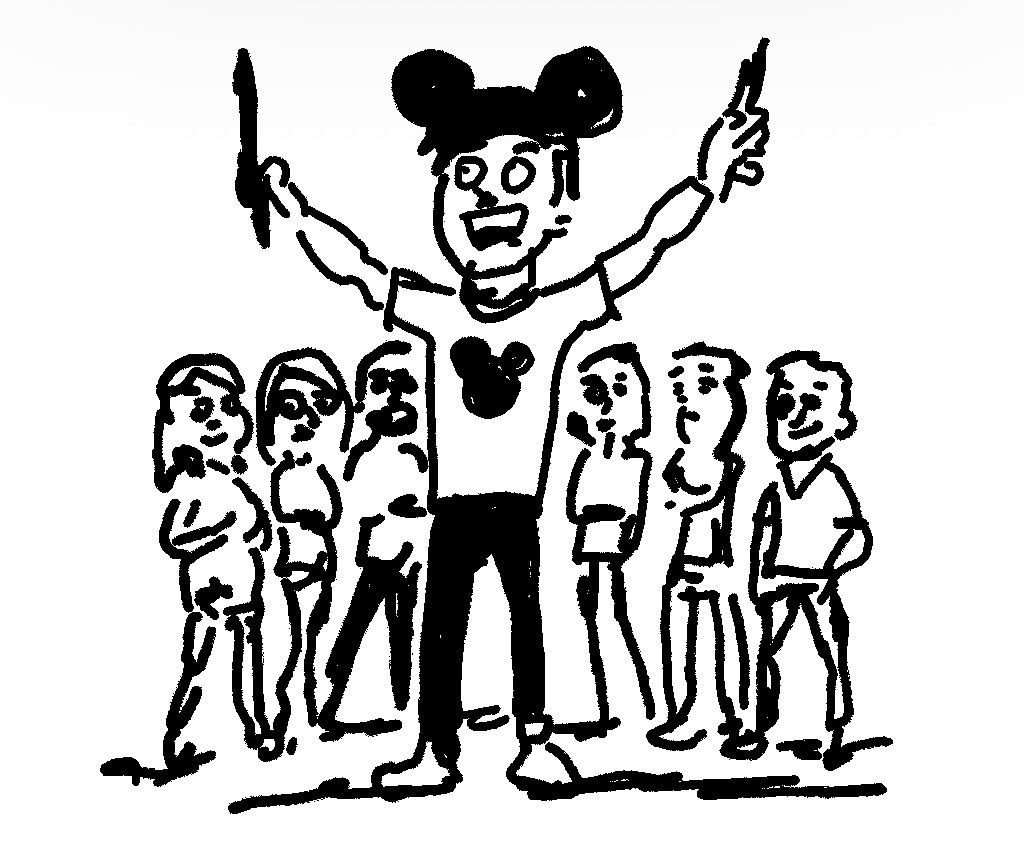
In the 1930s, at the absolute peak of the American entertainment industry — the most sophisticated, well-funded, star-studded production machine the world had ever seen — the two biggest cultural phenomena were an animated rodent and a ventriloquist’s puppet.
The mouse earned $140,000 in five weeks, net, and that was just the opening installment on what would become one of the largest entertainment empires in history.
Before Snow White even premiered in New York, a Paris silk house had already bought the merchandising rights to use the Snow White motif in fabrics.
Cartier followed a few months later.
When asked why Micky Mouse and Snow White were such huge hits Walt Disney replied:
“People are mostly simple-minded, they enjoy the simple things.”
Sounds almost insulting on the surface. But what he was really saying, with the kind of gentle self-awareness that was characteristic of him was something profound:
People don’t want to be impressed.
They want to be moved.
There’s a massive difference.
Impressed is intellectual. It’s “wow, that’s clever.” It’s admiration from a distance. But it also fades in minutes.
Moved is emotional. It’s “I felt something.” It’s identification. It’s the feeling of seeing yourself in a story, a character, a moment. It stays with you for years.
And the emotions that move people aren’t sophisticated. They can’t be.
They’re also ancient. They’re the same ones that have worked since humans gathered around fires.
They are the joy of seeing something small overcome something big or the satisfaction of watching the underdog win or the warmth of recognizing yourself in a character who’s imperfect but lovable or the comfort of sympathy or instinct of protective affection or the feeling of “never owning a Patek Philippe but merely holding on to it for the next generation.”
Mickey Mouse works because he’s small, scrappy, and clever enough to outwit things bigger than him. Snow White works because everyone knows what it feels like to be mistreated and still hold onto goodness.
None of this is complicated.
And that’s the whole point.
But this principle doesn’t just apply to entertainment. It applies to you. Right now. Whether you’re building a personal brand, running a coaching business, launching a course, trying to grow on LinkedIn, or just trying to get people to care about what you have to say.
The Biggest Mistake In Personal Branding Right Now
Bevause here is what I see every single day.
Someone decides to build a personal brand. They know they need to create content and “show up” and post consistently.
So they do what any Sanderson would do.
They sit down and try to come up with ideas.
“What do people want to know?”
“What topics are trending?”
“What can I teach that would be valuable?”
And this is where everything goes wrong.
Because the question “what do people want to know?” leads you straight into the most crowded, most commoditized, most forgettable lane in all of content creation.
Information.
And just like that you start cranking out “5 tips for…” and “How to…” and “3 mistakes that…” posts. Even worse, you start teaching and explaining and packaging up knowledge that, let’s be honest, is available in 47 other places from 47 other people who probably have more credentials than you.
And then you wonder why nobody engages and why nobody remembers your stuff.
And don’t get me wrong. I’m not saying that teaching is wrong. What I’m saying is that it’s not what you teach that matters. It’s HOW you teach it.
Because here is the truth:
People don’t want to know things.
People want to feel things.
That’s the lesson Disney figured out. That’s the lesson every great showman in history has figured out. And it’s the lesson that 95% of people building personal brands right now are completely ignoring.
Because they think they need more ideas but what they actually need is more emotion.
The Part Nobody Wants To Hear
Without a genuine emotional appeal at the center of your content no amount of money, ingenuity, effort, smarts, energy or AI powered insights can save you.
I mean it.
You can have the best production. The smartest strategy. The most sophisticated funnel. The biggest ad budget. The most polished brand identity or the most sophisticated AI insight automations money can buy.
If there’s no real, simple, human emotion at the core of what you’re putting out — it will not work.
No amount of spending can manufacture what Disney had with Mickey Mouse. No amount of clever marketing can fabricate what makes someone stop scrolling and feel something in their chest. You cannot buy, engineer, or hack your way to emotional resonance.
It either exists or it doesn’t.
But the reverse is equally true.
Without that simple vital appeal to simple human nature, no amount of money, or ingenuity or energy poured into preparation or promotion can ever create a phenomenon or spectacle worthy of people’s attention.
This why people who happen to stumble into the right emotional frequency can establish themselves overnight with zero strategy while the most carefully orchestrated campaigns in history fail because they were missing the one thing that actually matters.
This is the part that most people trying to build a personal brand completely ignore because everyone is obsessed with the vehicle. The format. The platform. The production quality. The growth hack. The AI tool. The insight. The posting schedule.
Nobody is asking the only question that actually determines whether any of it works:
Is there a real emotional appeal here?
Or am I just performing competence?
The Amateurs’ Trap: Confusing The Symbols With The Substance
And then there are the posers.
The people who don’t ignore showmanship. They think they’re doing it. They’re not. They’re doing something else entirely.
They’re copying the symbols of showmanship without understanding what showmanship actually is.
And the moment real showmanship escapes the hands of people who actually understand it, the moment amateurs get hold of it, they immediately start confusing the decoration with the substance.
You see this everywhere.
For example:
Look at the American political convention. I know it seems exciting, but when looked at carefully it is actually the most perfectly preserved example of dead showmanship in modern life. Every single politician follows the exact same stale routine. The band crashes into the national anthem or other ditty. The crowd cheers on cue, visibly manipulated, for a predetermined duration. The states are “led” by New York or Oklahoma. Balloons drop. Confetti flies.
The symbols are all there. The flags. The music. The spectacle.
But nobody feels anything. Not really. Nobody is moved. Nobody walks away changed. The routine has been the same thing for too long to do that. Everyone in the room knows it too. And yet they keep doing it, because they’ve confused the trappings of showmanship with the thing itself.
Now look at advertising.
Sales data has proven beyond any doubt that using color intelligently, to enhance the attractiveness of the actual product or to make a display feel more lifelike, produces massive results. I’m talking about sales increases of 300, 500, even 1,000 percent.
Don’t believe me?
What color is a Tiffany box?
But there’s a critical difference between using color to enhance something real and slapping bright colors on everything just to grab attention. An extra color used solely to attract eyeballs, without any connection to the product’s actual appeal, almost never pays for itself.
And yet thousands of intelligent businesspeople keep doing it. They keep displaying their brightest scarlets and vermilions in one form of advertising or another, in wistful hope that being loud is the same thing as being a showman.
It’s not.
Now look at the personal brand space and you’ll find the exact same pattern. Except now replace colors with ideas.
People see a successful creator with great insights and think: “I need better insights.” So they ask AI for better insights and what they end up with are a lot of cool and loud and controversial and flashy and pensive and trendy and viral ideas with zero substance.
Loud is not showmanship. Flashy is not showmanship. Pensive is not showmanship. Trending is not showmanship. Going viral is not showmanship.
Showmanship is two things.
Doing things differently
Making someone feel something real.
That’s it.
You can do that with an iPhone video and no editing. You can do that with a plain text post. You can do that in a conversation over coffee.
Or you can carefully curate your ideas and miss the mark entirely because you were so focused on the symbol of intelligence that you forgot to put an actual emotion at the center.
Don’t be the person with thousands of AI generated ideas and nothing to say.
Be the person with a real emotion and whatever camera and social media platform they happen to have.
The Publicity Lesson Nobody Understands
Think about what it means to have a platform.
Whether it’s a newsletter, a LinkedIn following, a podcast audience, a YouTube channel, you’ve essentially earned yourself a column, a space and a stage.
Getting that space is an accomplishment in itself. Most people never get even a small audience to pay attention.
But getting the space is the easy part. What you do with it is another.
A PR person who lands a free column in a major newspaper deserves credit for one thing: getting space that most people have to pay for. That’s a real achievement.
But whether that column is actually worth anything depends entirely on how richly it packs those inconspicuous human appeals we’ve been talking about.
The column itself is just the vehicle. The real question is: does what you put in it make people feel something?
This is exactly what’s happening in the personal brand space right now.
People are grinding to build audiences. They are posting every day, growing their followers, landing podcast appearances and building email lists.
And then they fill those platforms with… information.
Information like tips and frameworks and How to listicles.
It’s like winning a primetime TV slot and then airing a PowerPoint presentation.
But the space doesn’t matter. What you put in it matters.
And what you put in it needs to be as close as you can possibly get to creating the emotional equivalent of a Mickey Mouse ir Show White or something so elementarily, simply, humanly resonant that people can’t help but respond.
Showmanship Is An Artful Science.
Most people think showmanship is a creative skill. Something you’re born with. Like a talent or an instinct that some people have and others don’t.
It’s not.
Showmanship requires artfulness. But once that is mastered, it is also a science. And the professionals on Broadway or Hollywood treat it that way.
Human beings, when gathered in any group large enough to matter commercially, are so uniformly driven by the same few basic emotions, and so universally standardized by habit and inertia, that their responses can be said to be more or less predictable with almost mathematical precision.
These same few simple, stupid-sounding emotions offer the same mathematics of human action for figuring out distribution problems as any technical knowledge gained through spending millions on laboratory research.
The entertainment industry figured this out generations ago. They have box-office data going back a hundred years that proves the same emotional triggers produce the same audience responses every single time. In later years they’ve even narrowed it down to a type of storytelling called the heroes journey. But the big producers, relying on their own judgment, and egos and creative instincts, still keep the statistical data submerged. They’d rather talk about the box office as proof of their genius than use it as a science to avert their next failure.
Sound familiar?
It should.
Because the personal brand gurus do the exact same thing.
People who get lucky with a viral post will either treat it as validation of their instincts or proof of just how rational they are. And instead of studying why it worked, what specific emotion it triggered, what pattern it followed, what made the audience respond, they and you and I along with them, either just keep posting and hoping for another hit or barrier ourselves in hook strategies and formats and templates.
PT Barnum is one of the most creative businessman that ever existed and yet his circus couldn’t afford to gamble with just any attraction. With a daily overhead that would make most businesses panic, Barnum had to get it right every single night. He knew his customers down to the last detail . He even knew that the spare change left behind by people walking away from the ticket booth netted about $20 per show in forgotten coins.
That’s how precisely he understood his audience. (And no, he never said there’s a sucker born every minute).
“The show must go on” isn’t a sentimental catchphrase. It’s a slogan of professional competence.
Not a single of Barnum’s circus failed through summers and winters, booms and busts, every kind of economic cycle imaginable.
Why?
Because he treated audience psychology with the rigor of a laboratory discipline. Because he couldn’t afford to be conceited or care less. And that’s why he survived every economic crisis that wiped out “real” businesses left and right.
And one of the things that allowed him to keep surviving is the fact that he kept things very simple. Profoundly simple. Freaks and exotic animals and people doing amazing things simple. Not because they couldn’t be sophisticated. But because he understood that sophistication is a luxury that audience psychology doesn’t reward.
This should change how you think about everything.
No revolution in business thinking may be more important than an intelligent comprehension that showmanship is profitable because it is professional. And that professionals survive because they stay elementary.
Which means building a personal brand isn’t a creative guessing game.
It’s, well, a discipline. A discipline with principles that work reliably and that can be studied, practiced and applied with confidence.
And the principles are simple.
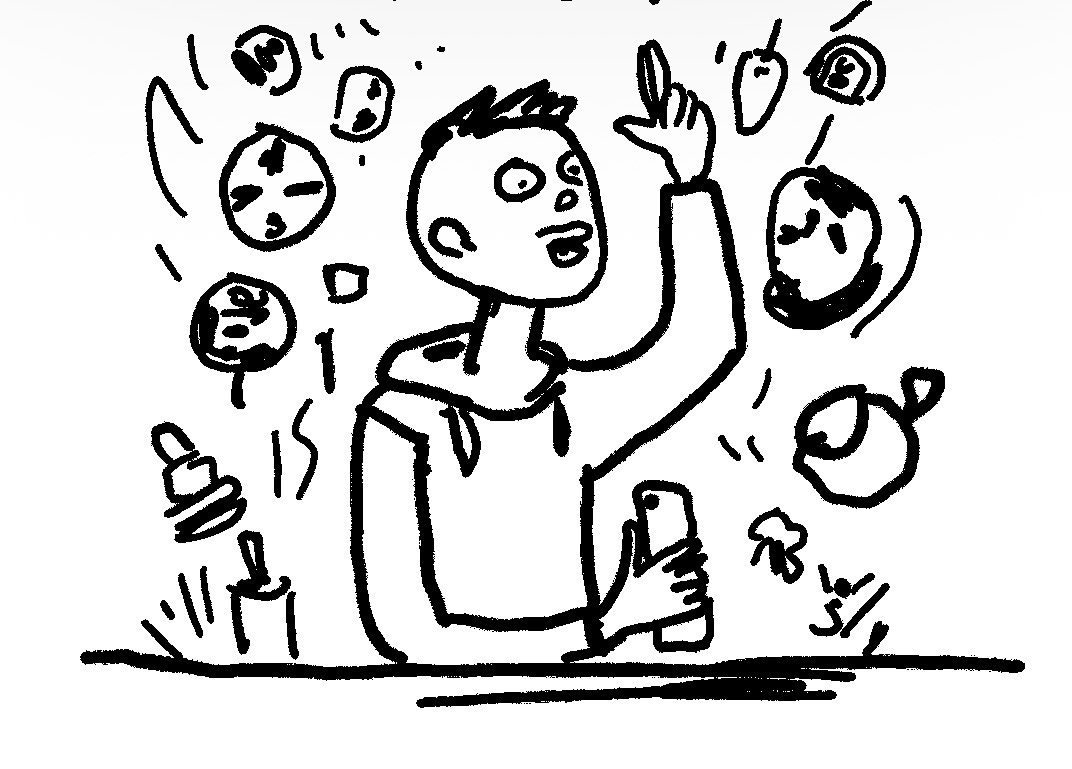
The Ideas Problem (And Why You’ve Been Solving It Wrong)
“I don’t know what to post.”
“I’m running out of ideas.”
“I feel like everything’s been said.”
If that’s you, I want you to reread everything above. Because the reason you’re stuck isn’t that you’ve run out of topics. It’s that you’ve been operating from the wrong starting point.
And that starting point is that you’ve been trying to figure out what people want to know, when you should be figuring out what people want to feel.
And those are two completely different questions that lead to two completely different kinds of content.
The first question, “what do people want to know?” leads to information. Stuff that’s useful for about thirty seconds and then gets buried in someone’s saved folder forever.
The second question “what do people want to feel?” leads to connection. These are Stories. Observations. Moments of recognition where the reader doesn’t just think that’s interesting but, “that’s exactly what I’m going through.”
And here’s the beautiful thing about the second question:
The answers to it are infinite.
Because there are only a handful of core human emotions, but there are endless ways to express them through stories, observations, experiences, and perspectives.
Fear of being left behind.
Frustration with feeling stuck.
The ache of knowing you’re capable of more.
The relief of realizing you’re not alone.
The thrill of seeing a new possibility.
Those are just a few. Start with those and keep going and suddenly you realize that you will never actually run out of things to say.
What This Means For Your Personal Brand
But having an infinite amount of emotional things to say is not the goal either. At some point, you have to narrow it down. So let’s get practical.
1) Find the elementary emotion.
Before you create anything ask yourself one question:
What’s the simple human emotion at the center of this?
Is it the fear of being left behind? The desire to be seen? The frustration of being stuck? The ache of knowing you’re capable of more? The relief of realizing you’re not alone?
Pick one and build everything around it.
Most people start with the vehicle, the format, the platform, the tactic, and try to bolt an emotion onto it afterward. It never works.
But Disney didn’t start with animation technology. He started with the feeling of watching a tiny, brave character overcome impossible odds. Then he moved on to fairly tails. The technology served the emotion. Not the other way around.
2) Make them the hero.
Every great piece of entertainment works because the audience can identify with the protagonist. Not admire then from a distance. Identify.
Mickey Mouse isn’t aspirational. He’s not rich or powerful or conventionally impressive. He’s a mouse. But he’s clever and persistent and he wins anyway.
That’s you. That’s me. That’s everyone reading this.
So when you create content think carefully about whether you are you positioning yourself as the impressive expert? If you are, stop. Start positioning them as the hero of a story they want to live instead.
This is why “here’s what I learned when I failed” outperforms “here’s my 7-step framework” every single time. Because in the failure story, the reader sees themselves. In the framework post, they see you. And people don’t share, save, or remember content about you. They share, save, and remember content about themselves.
3) Stop confusing attention with connection.
This is the bright colors mistake applied to content.
There’s a difference between content that grabs attention and content that creates connection. They are not the same thing. And optimizing for one often actively undermines the other.
Attention is a hook.
Connection is what happens after they stop.
Most people building personal brands or pontificating about them are optimizing exclusively for attention.
And they’re getting views. But what they ate not getting is loyalty, trust or the kind of relationship that turns a follower into a client.
Because attention without connection is just noise.
The real skill isn’t getting someone to stop scrolling. It’s making them feel something once they do.
4) Simplicity is the strategy.
This is the hardest one for smart people to accept.
If you’re reading this, you’re probably someone who thinks deeply. Who has complex ideas and sees the nuance in things and wants to communicate that nuance to everyone.
I get it. I’m the same way.
But as I keep saying and as the entertainment industry proves, the most commercially successful showmanship in history has been profoundly easy to understand .
Not dumbed down.
Easy.
There’s a difference.
Dumbed down is stripping away substance. Easy is finding the one simple truth at the core of something complex and expressing it so clearly that everyone gets it.
Disney didn’t dumb down storytelling.
He distilled it.
Good vs. evil.
Small vs. big.
Love vs. fear.
His stories were always one clean emotional line without any clutter.
When you write a post, you don’t need seven frameworks. You need one honest observation that makes someone stop scrolling.
Same thing for when you pitch a client, you don’t need a 40-slide deck. You need one story that makes them feel understood.
Or even when you deliver a service to a client. You don’t need twelve modules. You need one transformation the client can feel.
5) Consistency beats brilliance.
Barnum’s circus and museum survived every economic depression in American history. Every single one.
Not a single one of his endeavors failed.
And they didn’t survive because the shows were perfect. They survived because the shows kept going. Because they knew their audience so intimately, down to the spare change left on the counter, that they could deliver exactly what was needed, every single night, rain or shine.
In the personal brand space, this means consistent having consistent output. Consistent energy. Consistent presence. Consistent emotional resonance.
Because the person who shows up reliably with simple, emotionally resonant work will always outperform the person who shows up occasionally with something brilliant.
The Deeper Principle
We’ve been exploring this theme across multiple newsletters: your brand is not what you post. It’s what people experience. In rooms. On stages. Inside your company. In your content. Everywhere.
And now I’m telling you that the experience that builds the strongest brand is not the most sophisticated one. It’s the most emotionally true one.
The most profitable showmanship in history has been founded not on the amount of wit, ingenuity, money, or energy expended in the creation or in the preparation of production, or in any of these or all combined.
It’s been founded almost entirely on the essential validity of its basic emotional appeal.
So don’t get distracted by size, flashiness, fanfare, and intelligence. Those are what amateurs reach for first because they’re the most visible.
The substance, the thing that actually makes showmanship profitable, that actually makes personal brands stick, that actually makes audiences come back, is the easy to grasp emotional truth underneath all of it.
Speaking Of Never Running Out Of Ideas…
This is exactly what I’m breaking down in my free May Masterclass: “How to Never Run Out of Interesting Ideas Ever Again.”
It’s the system I use to generate content that actually connects, not by chasing topics, not by copying what’s trending, not by Googling “content ideas for coaches”, but by tapping into the emotional layer that makes everything you create feel alive.
Everything in this newsletter, the elementary emotion principle, the difference between impressing and moving, the shift from “what do they want to know?” to “what do they want to feel?”, the science of showmanship, the difference between the symbols and the substance, I go deeper on all of it inside the masterclass.
And it’s free.
Sign up here → https://stan.store/justinoberman/p/free-may-masterclass
A cartoon mouse beat Hollywood.
Not because the animation was better than a feature film. But because a small, brave, imperfect man made a small, brave, imperfect character that made millions of people feel something real.
That’s showmanship.
That’s personal branding.
And that’s it.
Thank you for reading.
– Justin Oberman
Follow me on LinkedIn
Join 4k people avoiding the Guru trap. Subscribe to my weekly LinkedIn expose TheAnti-Guru