Why you really lose pitches
And how a little showmanship can fix it

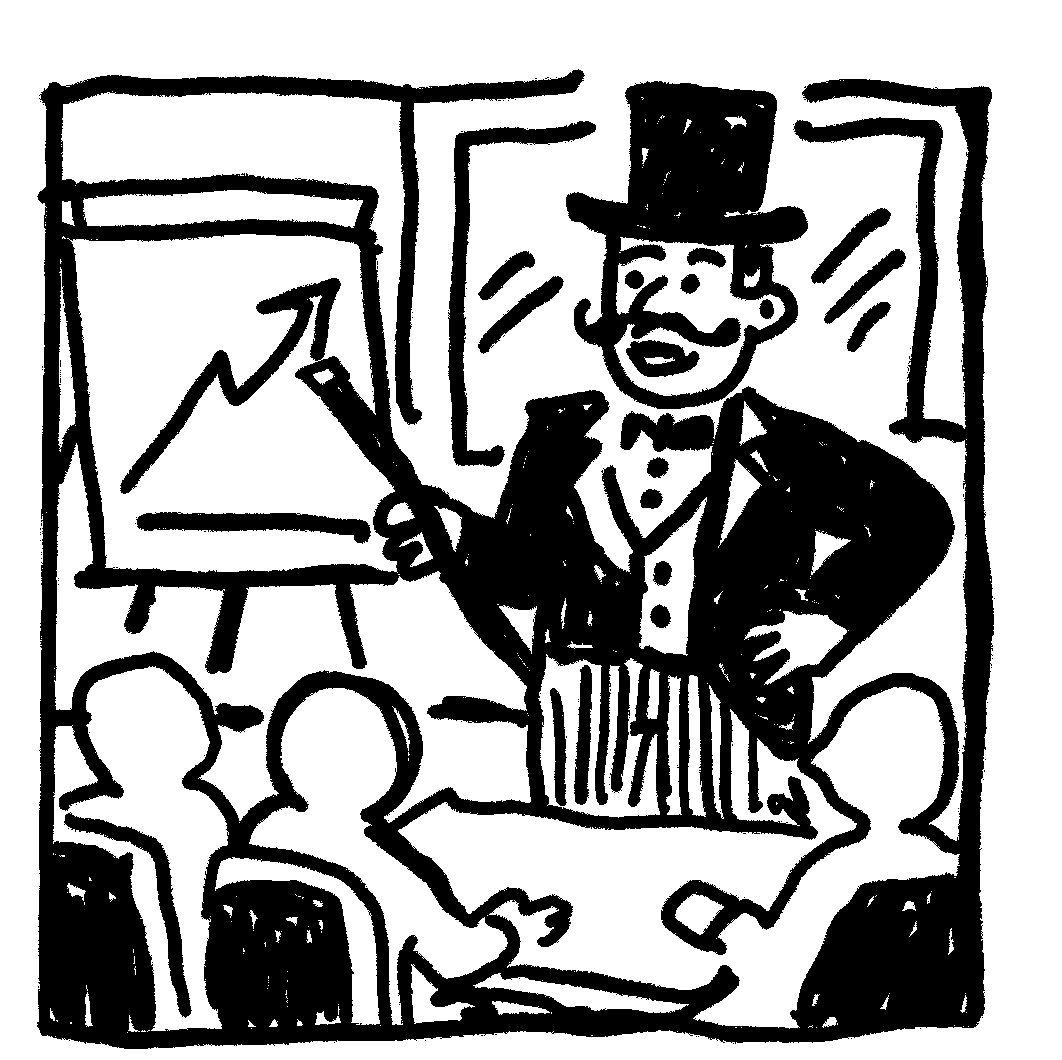
Most pitches are corporate torture.
Death by PowerPoint, bullet points that say nothing, stock b-roll of people in suits pointing at charts.
The speaker drones on about "synergistic solutions" and "paradigm shifts" while everyone mentally checks out after slide three (or, if you made the mistake of sending them a PDF version, just skips to the part where you talk about costs and waits patiently for you to get there while pretending to look like they are paying attention)
But here's the truth nobody likes to talk about:
Besides affecting your income and whether people take you seriously, your presentation skills and the way you pitch also affect your personal brand.
Just like on social media, you can have the best ideas in the room, but if you can't communicate them effectively in a pitch, you might as well not have them at all.
But the way to present ideas in a pitch is very different from the way you present them in a social media post.
Most people think good presentations are about having good slides, facts, or information.
They're wrong.
I have won 6 figure picthes using nothing but a napkin and a pen. I once won a pitch by reciting Rilke.
A good presentation has nothing to do with facts or pretty slides.
It's about making people feel something and creating an experience that shifts how they think and what they do next.
The French Connection
Marcel Bleustein-Blanchet, the French founder of Publicis (one of the world’s largest advertising firms), understood this perfectly.

In his memoir The Rage to Persuade, he tells a remarkable story about coaching Charles de Gaulle after the general’s first disastrous television speech in 1958.
De Gaulle had him come to his office to discuss it.
“Mon Général, they slaughtered you!” Bleustein-Blanchet said. “They showed you in profile with your glasses on your nose, reading a text. When you’re General de Gaulle, that’s no way to get into people’s homes.”
De Gaulle responded: “I am familiar with radio, but not at all with television. What should I do, in your opinion?”
“Well, remove your glasses, speak without notes, and let your face burst out on the screen.”
“What does that mean?”
“It means that your expression and your eyes must be in close-up. They’re the only thing the audience should see.”
Some time later, de Gaulle invited Bleustein-Blanchet and his wife to dinner at the Élysée Palace. His wife said, “I saw you on television last night. You were fantastic! Speaking without notes. You must have a remarkable memory.”
De Gaulle laughed. “It’s all your husband’s doing. He made me take off my glasses, and now I memorize my speeches and say them by heart!”
Here was the most powerful political figure in France — a man who had led the Free French Forces, liberated Paris, shaped the destiny of a nation — and he understood that the medium demanded a different kind of mastery.
If de Gaulle could learn to become a performer, so can you.
The Fatal Flaws
It honestly used to shock me how bad some people in advertising and marketing are at presenting.
Think about this for a second.
Here are people who know how to create award-winning, highly successful ad campaigns for soap. For sneakers. For billion-dollar brands.
But when it comes to selling their own ideas?
They always fall back on the same fatal flaws that their own clients have. The same mistakes they’d never let a client make in a commercial.
It’s the shoemaker’s children going barefoot.
Let me break down the eight biggest ones.
Fatal Flaw #1: Solving the Wrong Problem
Most presenters think the goal is to convince people.
It’s not.
The goal is to persuade them.
There’s a massive difference.
Convincing is about logic. It’s about lining up facts and arguments and hoping the other person reaches the same rational conclusion you have.
Persuasion is about moving someone, about shifting how they feel, and what they believe, and what they want to do next.
Another popular way of saying this is that convincing speaks to the brain while persuasion speaks to the heart. But I prefer to say, the whole person, the whole person, because the heart pumps blood through the wholeperson.
The reason why people often make this mistake is that, unlike convincing, persuasion can take on many forms. That is to say, sometimes the best way to persuade someone is not the straightforward way.
That doesn’t mean lying or manipulating. It means understanding that human beings are not spreadsheets that make decisions based on bullet points. They make decisions based on how something makes them feel, and then they use the facts to justify it afterward.
Facts are what people use to justify their decisions. Not to make them.
So stop trying to convince. Start trying to persuade.
Fatal Flaw #2: Hiding Behind Slides
Everyone obsesses over their decks.
Some people say they should be only 10 slides. Some are OK with forty. I once was part of a pitch that had over one-hundred and sixty!
People also get obsessed with beautiful transitions and custom animations.
But the best presentations I’ve ever given used zero slides.
Or one slide.
Or a napkin.
Let me ask you something.
A few newsletters ago, I defined showmanship as simply not doing whatever you are doing the same way everyone else is.
I used Tiffany’s as an example. When Tiffany’s first launched, they didn’t pick a logo. They picked a color. Their first catalogue literally didn’t have their name on the cover. It was just pale blue.
So if you really want to be memorable (if you really want to stand out from the seven other agencies or consultants pitching that same client this week), why would you do the same thing everyone else does?
Everyone walks in with a polished deck.
What if you walked in with a whiteboard?
What if you drew your ideas out in real time, right in front of them like a habatchi chef?
What if you built the strategy on a chalkboard like a football coach drawing up a play?
That’s showmanship.
And if none of this convinces you, then consider this:
The medium is the message.
So when you show up with a massive deck, the unspoken message is: “I prepared this in advance, and I’m going to walk you through it whether you like it or not.”
But when you show up with a marker and a blank surface, the unspoken message is: “I know this material so well that I can build it from scratch right in front of you. And I’m flexible enough to go wherever this conversation takes us.”
Which person do you trust more?
The deck is a crutch. And like all crutches, it prevents you from building the strength to stand on your own.
Fatal Flaw #3: Sending Your Presentation Before You Present
This might be the single most destructive habit in business today.
Someone from the client’s team sends an email: “Hey, can you send the deck over before the meeting so we can review it?”
And most people just... do it.
They hand over their entire presentation before they’ve had the chance to present a single word.
This is suicide.
Here’s why.
A presentation is not a document.
It’s a performance.
And a performance without a performer is just a script sitting on a table.
When you send your deck in advance, you give people the ability to form opinions without you there to guide them. They flip through the slides at their own pace. They skip the ones that don’t immediately grab them. They read the recommendations out of context. They misinterpret the strategy because they don’t have your voice, your energy, your emphasis shaping how they receive the information.
And the worst part?
They’ve already made their decision before you walk in the room.
You show up to present, and half the audience has already decided they don’t like slide fourteen. They’ve already formed objections you haven’t had the chance to preempt. They’ve already discussed the ideas among themselves in a conversation you weren’t part of.
And just like that, you’re no longer presenting. You’re defending.
Think about it from a showmanship perspective.
No magician sends the audience a video of how the trick works before the show. No comedian emails the punchlines the day before the set. No director mails you the screenplay before the film opens.
The experience is the product.
And when your product is a pitch (or the ideas in the pitch), you cannot create an experience if someone has already consumed the content in the worst possible format, alone, without context, scrolling through a PDF on their phone between meetings.
So what do you do instead:
Here’s the system:
When someone asks for the deck beforehand, you say:
“I understand, but we have a policy to walk you through it in person. That way, we can answer any questions or solve any problems in real time. Which gives you an even deeper understanding of what it’s like to work with us. But I’m happy to send a brief agenda, so you know what we’ll cover.”
To be honest, you should be doing that last part anyway. But the important part is that now you control the frame, pacing, and narrative of your presentation. Which is so important because whoever controls the presentation controls the outcome.
The moment you hand over your materials before you’ve had the chance to perform them, you’ve surrendered that control. You’ve turned your showmanship into a document. And documents don’t persuade anyone.
People persuade people.
Never let someone else experience your ideas without you in the room to bring them to life.
Fatal Flaw #4: Leading with Facts Instead of Emotion
This one drives me absolutely crazy.
Especially in the advertising world.
My bosses would never dream of recommending that a client create a commercial that presented facts before the emotion. They’d never tell Nike to lead with the chemical composition of their shoe foam before showing the athlete crossing the finish line.
And yet, whenever those same bosses pitched ideas to clients, what did they do?
They led with the strategy.
“Here’s the market analysis.”
“Now let’s move on to the competitive landscape.”
“Now here’s the customer segmentation.”
“And just to refresh your memory, here’s the brief.”
That’s thirty+ minutes of strategy and data before anyone even sees the creative work.
By the time you get to the actual idea (the thing the client is really there to see), they’re already mentally exhausted, and you’ve turned what should be a revelation into an afterthought.
Here’s the framework (stolen from the way the best communication works) that actually works:
Lead with emotion.
Just trust me (and yourself) on this.
Make them feel the idea first. Make them experience what it would be like to see this campaign in the world. Let the creative work hit them in the gut before a single strategy slide appears.
Then (if they still want it) give them the strategy.
Because strategy is not how you win pitches.
Strategy is how the client justifies the decision they already made with their gut.
Read that again.
Clients don’t choose the best strategy. I know they say that that the do. But they don’t. They choose the idea that moved them the most, and then they use the strategy to explain that decision to their boss.
But if you lead with strategy, you’re asking them to make a rational decision before they’ve had an emotional experience. And that’s not how human beings work.
Fatal Flaw #5: Relying on Suspense
Most presentation advice tells you to “build anticipation.” Structure your pitch like a mystery. Don’t reveal the conclusion until the end. Keep them guessing.
This is terrible advice.
You know why? Because uncertainty creates anxiety. Anxious people don’t buy.
Movie trailers prove this to be true. You see the hero, the villain. The conflict, the emotional stakes. Sometimes they even show you the climax.
And you go see the movie anyway.
Because knowing what’s coming doesn’t reduce desire.
It increases it.
Steve Jobs understood this better than anyone. If you watch his Keynotes carefully, you will notice that he begins every single one by telling them everything they are going to hear
He told you what was coming. And then he showed you.
So the only thing you should talk about before getting into the creative work is the outline of what they will see or hear today.
Tell them everything. Well, not everything. But we will get to that later…
This isn’t a new framework, by the way. It’s ancient Aristotelian rhetoric. And it works because it does three things:
It sets expectations (which reduces anxiety)
It creates anticipation (which builds desire)
It reinforces memory (which ensures retention)
Don’t be afraid of giving away the plot.
Because when you tell someone what you are about to tell them, two things happen:
They get excited. And they start paying very close attention because they want to see if you deliver on that promise.
It also makes you look insanely confident.
Fatal Flaw #6: Explaining When You Should Be Demonstrating
If you will look past the misogyny for a moment, there are two scenes in Mad Men that anyone who ever has to pitch anything needs to study (well, actually, there are three, but we will not be talking about the carousel one today).
A creative is presenting an idea for a campaign for bras. Instead of describing the concept, or walking through a strategy deck, or explaining anything, he simply opens the door to the office and starts pointing at the women working outside
“That’s a Jackie. That’s a Marilyn.”
He didn’t explain the insight about how all women see themselves as one archetype or the other.
He demonstrated it right there, in real time, using the actual people in the room.
And the idea landed with the force of a thunderbolt.
When Don Draper presented it to the client a few weeks later, he did the same thing.
Most people think the words they say are the most important part of a pitch.
They’re not.
Unless the way you’re talking is itself a demonstration of the idea.
Think about it this way.
If you’re pitching a campaign about boldness, and your pitch is timid and safe, the client will never buy it. The pitch itself should embody the principle of boldness.
The same thing with a simple idea.
If you’re pitching a concept about simplicity, and your deck has forty-seven slides, you’ve already lost.
The greatest pitchers are performers. They don’t describe their ideas; they bring them to life in the room.
This is also a great example of how personal brands are built offline as well as online.
Because how you present is a demonstration of how you think, create, and what the client can expect when they hire you.
So stop explaining and start performing.
Fatal Flaw #7: Treating the Audience as Passive Consumers
This, of course, doesn’t mean that your words aren’t important. But it does mean how you use them does.
The old one-way communication model of presenting is: I talk, you listen.
That’s a lecture, not a pitch.
Thanks to social media, people are used to a more interactive style of communication.
But a true showman has always understood this. A true showman knows that an audience is never just watching a show. They’re in the show.
Even when the communication medium is one-way, the best performers have a way of making you feel like you are there, or even that you are them.
For example:
Even in large arenas or through television screens, performers like Paul McCartney are known for looking directly into the camera or at audience members, making it feel as though they are singing to each person individually.
This is easier for you to do during a pitch.
So instead of talking at people for forty-five minutes, involve them:
“Show of hands, how many of you have experienced this exact problem?”
“Take thirty seconds and discuss this with the person next to you.”
“I want to hear from someone in this room, what would you do differently?”
When people participate, they become invested. They become co-creators of the idea. And people don’t reject ideas they helped create.
Fatal Flaw #8: Ignoring Your Instrument
Your voice is your primary tool.
Most people use it like a broken hammer.
Monotone kills presentations faster than bad slides ever could.
Here’s what actually works:
Slow down for important points. Speed up to build excitement. Pause (really pause, for an uncomfortably long time) before revealing key information. Vary your volume strategically.
Of course, when and where you do this depends on your performance.
For example:
Most people think louder equals more important. But sometimes the most powerful thing you can do is whisper the crucial stuff. Make them lean in to hear you.
Your voice should mirror your content, not fight against it.
Most people never work on this because most people hate the sound of their own voice.
Get over it.
Practice this. Record yourself. Listen back. Cringe. Then fix it until you sound like someone else.
So what does all of this add up to?
A system.
Here’s how to actually think about presentations if you want to become someone who persuades rather than just presents:
1. Lead with emotion, close with logic.
Make them feel first. Give them the strategy second. The feeling is the decision. The facts are the justification.
2. Ditch the deck (or make it minimal).
If you must use slides, make each one a single image or a single sentence. Better yet, draw your ideas live. Be the presentation, not the slide.
3. Tell them what’s coming.
“You’re going to love this.” “What I’m about to show you will change how you think about X.” Set the frame. Build desire through confidence, not suspense.
4. Demonstrate, don’t explain.
If your idea is about boldness, be bold. If it’s about simplicity, be simple. Let the pitch itself be proof of concept.
5. Make them participants, not spectators.
Ask questions. Create moments of interaction. Turn the audience into co-creators.
6. Master your instrument.
Your voice, your pace, your pauses, your eye contact. These are your tools. Treat them with the same seriousness a musician treats their instrument.
7. Do what nobody else does.
This is the core of showmanship. If everyone brings a deck, bring a whiteboard. If everyone leads with strategy, lead with a story. If everyone explains and demonstrates.
The person who does what nobody else does is the person nobody forgets.
BUT NOT EVERYTHING IS ALWAYS ABOUT DOING THE OPPOSITE.
When it comes to presenting, there are some fundamental rules, laws, or guidelines that cannot be ignored.
The Five Rhetorical Rules, Laws, or Guidelines of Presentations That Command Attention
1) Make Abstract Concrete
Numbers don't move people. Stories do.
Don't say "This will increase efficiency by 15%."
Say, "This saves every person in this room 2 hours per week. That's 2 extra hours with your family, or 2 hours to work on projects that actually matter."
Don't say "Customer satisfaction improved."
Say "Remember Sarah from accounting, complaining about our slow response times? She sent me this email yesterday..." [reads actual email]
Always transform data into human impact.
2) Create Tension
People like to avoid talking about the negatives of any situation.
This is a huge mistake.
Think about it. A movie without a negative scenario is boring. Without Mordor and Sauron, The Lord of the Rings would just be about the adventures of funny-looking people with expensive jewelry.
The philosopher John Dewey was famous for saying that we only philosophize when we are solving problems. Or, in other words, people pay attention to problems, not solutions.
So when you are presenting, start with conflict and make the status quo unacceptable.
"While we're debating this decision, our competitor just captured 30% more market share."
"Every day we delay costs us $8,000 in lost productivity."
"If we don't act by Q2, we're looking at our first round of layoffs in company history."
“The current ad campaign is fun, but people aren’t noticing it.”
When you create urgency, you make inaction painful.
3) Show, Don't Just Tell
Yeah, I know. I already mentioned this above, twice. And that’s why I am mentioning this again. Because it’s really important. But instead of repeating myself, let me put it in the context of the rhetorical guidelines being discussed here.
Live demos beat screenshots every time.
Real testimonials beat fake stock photos.
Actual results beat theoretical projections.
If you're pitching a new system, show it working in real time.
If you're presenting results, show the before-and-after.
And, if you're proposing a solution, demonstrate it live.
Your audience should see the transformation, not just imagine it.
So do anything you can to make the idea you are selling real, right now, on Zoom or in the room.
4) Build Anticipation
I know. I know. Above, I said don't rely on suspense. But this is different. This is about anticipation.
There is a difference.
Suspense keeps people guessing. There is a certain level of uncertainty involved.
Anticipation, on the other hand, involves knowing just enough to eagerly await it.
So don’t keep people hanging, but don’t give away your conclusion in slide two either.
Structure your presentation like a detective story:
Present the mystery (the problem)
Gather evidence (data and analysis)
Reveal the solution (your recommendation)
Don’t keep them in the dark, but keep them guessing and build toward the climax.
You can do this by using phrases like "But here's what's really interesting..." or "The data revealed something unexpected..."
Again, Steve Jobs was the master at this. After giving you a roadmap at the beginning of his Keynote, he would always add something like, “You are really going to love it.”
Notice how he didn’t say, “I think you are going to love this.” He tells you:
“You ARE really going to love this.”
Make them lean forward, not check out.
5) One Clear Message
This is the hardest thing for people not to understand, but to actually practice.
Most presentations try to cover everything.
In a famous marketing lesson, the creative ad legend Lee Clow taught Steve Jobs the power of simplicity by throwing paper.
When Jobs kept insisting on cramming multiple product features into an ad, Clow crumpled five pieces of paper and threw them at Steve, yelling, “Catch!” Steve missed all of them. “That,” Clow told him, “is an ad with too many messages. A bad ad.” He then wrote down something on a piece of paper, crumpled it, and threw it at Steve again, yelling, “Catch!” This time, Steve caught it. Clow then told Steve to open it up. On the piece of paper were all the product features Steve wanted to highlight. “That’s the power of a good ad.”
The best presentations focus on one thing.
One decision. One change. One next step.
Everything else is supporting evidence, a justification to support the main idea.
If your audience can't summarize your main point in one sentence after your presentation, you've failed.
The Digital Age Reality
Whenever I talk about this to audiences, there is always someone who gets up and says something like, “Yeah, this all makes sense when you are presenting live, in front of other people, but most pitches these days are virtual.” To which I always reply…
“Exactly. And that is what makes learning these showmanship techniques more important than ever.
Virtual presentations aren't just different from in-person presentations.
In fact, they're harder.
Your audience is one click away from checking their email, one notification away from losing focus. And as anyone who has ever been on an important Zoom call knows, one technical glitch away from tuning out completely.
“Can you hear me now?”
“You're frozen.”
This means everything about your presentation has to be not only tighter but also more engaging and interactive.
The old rules still apply, but flawless execution is required.
Test your tech twice. Have backup plans. Control your environment. Notice when people are looking at something else. Learn how to eliminate distractions by pulling them in.
This may sound crazy, but when you are pitching over Zoom, you are competing with a lot more than just their attention. You're competing with Netflix, Instagram, and every other dopamine hit available on their device.
You need to make your presentation more compelling than thos dopimine hits.
The Deeper Truth
Showmanship isn’t manipulation. It isn’t trickery. It isn’t about being the loudest person in the room.
It’s about understanding that every interaction is an act of persuasion. And persuasion (real persuasion) requires you to respect your audience enough to give them an experience, not just information.
This is why I emphasize mastering the art of self-publicity over mastering the art of buildinga personal brand.
And not just because self-publicity is what builds personal brands, but because self-publicity is like courtesy. It’s an oil that helps prevent social cogs from squeaking. Learning the art of Self-Publicity helps you put your best, most entertaining self in front of people. And, people produce better, buy better, and engage better when they are taken into account.
When they feel something.
When they’re treated like real people.
The choice is yours.
Most people think the only place to build a personal brand or practice the art of personal publicity is online. This newsletter is one of many examples that prove how this is’t the case. My digital course on Mastering the Art of Personal Publicity covers the rest.
My monthly FREE masterclass also covers some of this, which you can watch now if you can’t wait for the next one.
– Justin Oberman
Join the 60k people following me on LinkedIn
p.s This is really my email address. If you reply, I will see it.